Showing posts with label techniques. Show all posts

7 Sept 2014

Wet on wet, for the first time

With Old Gnome waiting for the skin to be finished, I felt I need to 'warm up' a bit on another model. You know, it's always easier to start over again when only the face is painted, not the whole miniature. I decided to go with SK Miniatues piece.


Beautiful Landsknecht bust (scale 1:9), sculpted by Yury Serebryakov. Pretty big face, and the rest looking deceptively simple and fast to paint. And what's more important, I got it p repared already for few months now. At some point I decided to prepare and prime several miniatures and busts. If you're courious about my preping process, I described it in some more details few posts (and almost a year) ago.


And, as you probably can imagine, I got carried away.


With face basically finished (just few touch ups here and there, when whole thing is done) I just continiued painting. For the first time I managed to successfully use wet on wet technique. Till now I was struggling with big time. I've seen countless video tutorials on this technique (well maybe not countless but a lot for sure), but couldn't get it right. Luckily this time it just worked. I'm especially happy with the red of the tunic and black on the emblem on the front. Both red and black were really difficult for me to paint with high contrast, and this time I quite like the effect. I hope I'll be able to use this technique from now on without any problems. Below you can see a massive close up of the red and black elements. It looks kinda rough here and there, but please bare in mind that the photo is few times bigger than the whole bust, so of course all imperfections are well... bigger.


Right now it's almost finished, just like the Old  Gnome piece... And I can only hope I can finish both of them without further distraction.
The face is somehow desaturated on the photo. I seem to be unable to get the colours right on my new camera, but over all I'm pretty happy with how it turned out. Like I said I'll be doing some more work here, but I'm almost there.
For the rest of the bust I need: repaint the pouch on his chest (draws way too much attention away from the face), fisnish the belt, shirt, beret, golden elements, and of course beard.

cheers
'eM


4 Jun 2013

Anker guy

And here are few solo photos of the 'Anker guy'.
Colours are slightly 'patchy' (to put it mildly) and the skin looks extremely messy, but I'm experimenting with techniques a bit here. Some preshading mixed with building volumes while applying base layer.
Might be a total disaster, but I feel I need to give it at least a try;]


cheers

'eM

24 Mar 2013

Best freehand ever:D


Quick WIP of one of my many many projects... Bloody Yoda from Knight Models.
Quite an early stage, clothes are just mess after trying new technique (not really working thb;/), but the face is almost ready. Of course there is still some work to be done but at least you can see features of his face... And that's all freehand, seriously. At the poto below you can see him just after priming. only the nose and right eye are more or less visible... Left eye is just a blob, mouth... is somewhere under the nose. And tbh that's the face after an exchange;] The first cast it was just one porous blob instead of the face... So I must say, I'm proud of his face now, and of my freehand skills;]


cheers

'eM

16 Mar 2013

Textured material - approach 1

This article on how to paint fabric texture has been moved to it's new home: Minichix Studio website.

You can read the new, better version of the article about texturing materials here.

6 Sept 2012

The Grinder - little update

Still lots to do, mostly skin (and eyebrows!!), but I guess I can see the end here;]

Leather elements and that fabric around his hair are finished.
Hair itself and metal elements need some final definition. Other than that, only skin left.
At this point I must say I'm particularly happy with the look of the cloth (some close-ups below). That was the first time I was trying to mimic this kind of texture.
And what do you think? Does it look real or not really?


cheers

'eM

12 Aug 2012

Textures - crushed velvet

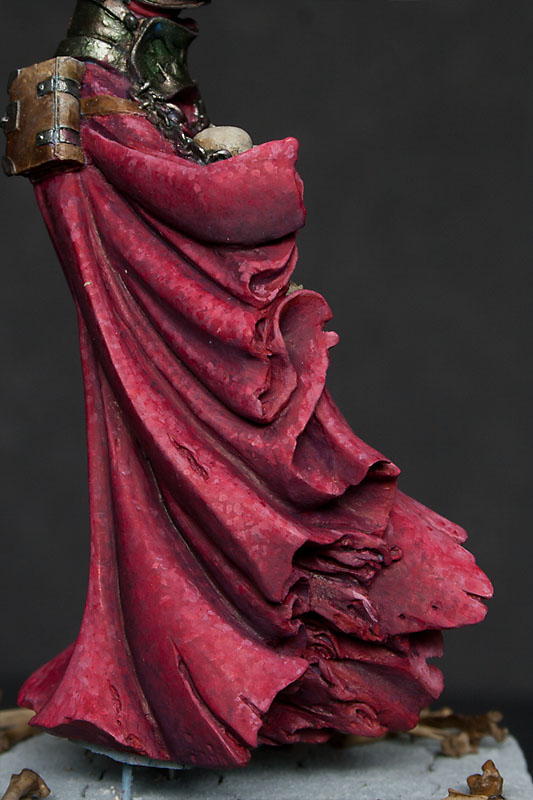
This time I'll try to explain how I did the velvet robe on Menhom Dark Shadow.


I started the robe as plain red. As you can see I even added some initial lights and shadows. But then I realised that this robe is big enough (I'd even say huge) to add some freehand, or maybe texture.
Because initially I was going for old and dusty look, the embroidery, I was going to mimic with freehand, would have to be fairly damaged. I wasn't sure  if I'll be able to do that, so I decided to go with crumpled velvet look.

To do that I decided to try 'doting' technique presented by Alexi_Z in her video tutorial. That was my first try, so the results are far from ideal, but I'm quite happy anyway. I learnt a lot doing that piece, and the next attempt should be more successful.

On the first two pictures you can see the initial shading on the robe. It's not perfectly smooth or too contrasty, but it's OK. I'm gonna cover it with lots of dots.


When I made my mind how exactly I I'm gonna paint the robe, I did a little try on one of the creases to find out If I'm capable of pulling that off.


It looked quite nice, so I started to build shadows.
On the pictures below you can see how I was trying to control depth of the shadows not only by used colour, but also by placing more or less dark dots in the recesses.


Then I started to add dots with brighter colours to create lights. Like with painting smooth surface I was building lights gradually, by change of colour and placement of the dots.

Later it was mostly going back and forth with various shades to build a nice gradient. I used quite a lot of base colour to make shadows and lights less uniform. To soften the transitions a bit and made it look more like a fabric, not just collection of dots, I used some red glazes.


On the pictures below you can see the difference glazes did. Colour is more vibrant, and whole robe looks more consistent.


 And here, finished robe, with some final highlights on the edges.


And at the end, colours I used to paint the robe, maybe someone will find it helpful. I know that I'm using some really old and discontinued GW colours, but you can easily find something similar in other ranges.

Base:
Red Gore (GW)

Highlights:
1st light Andrea Flesh Paint Set
Offwhite (70820 VMC)

Shadows:
Liche Purple (GW)
Storm Blue (GW)
Black (70950 VMC)

Washes (GW):
Baal red
Devlan mud
Leviathan purple
Thraka green


cheers

'eM


30 Jul 2012

Textures - some sort of weird introduction

Recently I've been thinking about texturing that imitates fabrics on miniatures (due to my two beautiful Pegaso boys). Which scale is big enough to give it a try, to make it look natural, not only to show off.
Should we do that while painting miniatures up to 90mm, or maybe only bigger? Does it look realistic, or not really?
Sure, when it's done right it looks pretty awesome (for a freehand), shows the skill and dedication of the painter (you know, all these long hours he/she spent painting all the tiny lines). But is it necessary and believable?
Does it add more realism to the mini, or maybe is a bit over the top? I must say I do have my doubts, but still didn't make my mind.

Let's think about it for a moment, and look at some pictures:

Here are some close-ups of contemporary fabrics and photos of clothes made of them.


Silk


Wool


Linen


Velvet


I don't think threads of any of these fabrics would be visible even in scale 1:20. Well maybe except of thickest wools and roughest  linen. And of course old and crumpled velvet, but that's completely different thing.


But you may say: it's all contemporary fabrics, made by fancy machines. And what about old times?


Personally I don't really think it was that much different from now. Of course the technology of weaving, and used tools were different, but let's give some credit to our ancestors. Even in the middle ages people were able to weave some fine and delicate fabrics. 

Quoting Vikings Online:
 "The Vikings were not the barbarians that our Victorian forefathers imagined, so extremely coarsely woven cloth such as sack cloth, is not required for clothing. 10 threads per centimeter was average, whilst 60 threads per centimeter was not uncommon for extremely fine material." Source

Let's do the math:
10 threads per 1 cm, 1mm thick thread, and
in scale:
- 1:10 it's 1/10mm thick single thread,
- 1:20 it's 1/20mm thick single thread,
- 1:35 it's 1/35mm thick single thread. 


And that's the thick wool... Made by Vikings. How much better should it be on royal courts in more developed parts of the world?

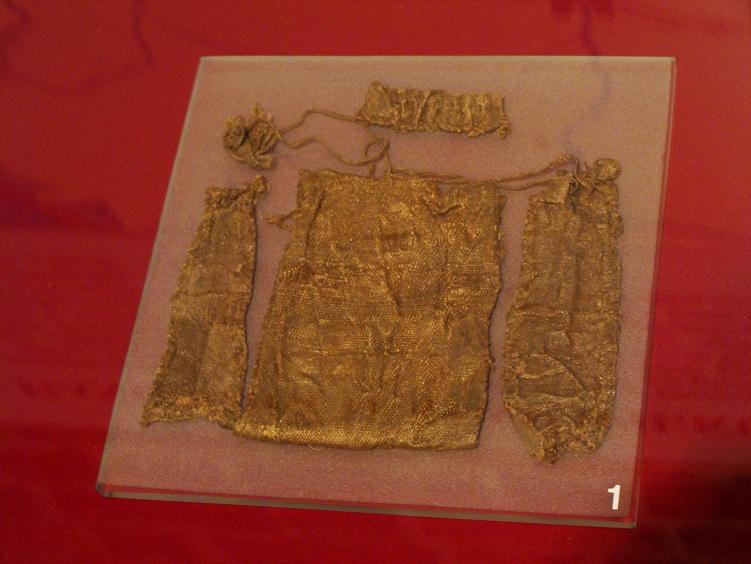
Here are some examples of real medieval fabrics found in archeological excavations.

silk brocade

silk
source


wool
source

As you can see it's not that primitive and thick as we could imagine.

Looking only from that point of view, all attempts to recreate a fabric on a mini smaller than 1:10 is kinda pointless. Try to imagine how extremely thick would it be when increased to the real size...
Silly, isn't it??:>

But on the other hand....
Textured fabrics, if done properly, and not on every single piece of clothing, definitely add some visual interest to the mini (even if it hurts a little when we think about the 'real' thickness of the painted fabric).
After all, the contrast we build on a mini is way out of proportion to the real life, but it helps to show three-dimensional of the mini.
So maybe textured fabrics, if done with some sense, may be a really nice addition to the mini and not only show off?
I really don't know;p  I'll probably try at some point just to prove myself that I can do that good enough. And even said that, I don't think I'd ever dare to 'recreate' threads of silk or other delicate fabrics or on clothes of nobility and kings, but maybe on a woolen cloak it wouldn't be too bad?

And there is one more aspect of this textured affair...
Maybe it's only a temporary trend to paint fabric's threads everywhere it's possible, just to push the border of what's possible in this hobby a little bit further? Maybe it will pass at some point and we'll all get back to the smooth painting?


How do you think?
Am I making mountains out of molehills, or do we have a topic for valid discusion?


cheers


'eM