Showing posts with label step by step. Show all posts

28 Mar 2015

Al Hippone's plaque - short SBS

This is gonna be really quick SBS, mostly photos (some of them not very good, using my phone's camera is much easier but there is always a risk that photo won't  be super sharp),  of how I made my plaque for Al Hippone.

First the idea was to order a plaque from Name It, as I always do. I like their elegant finish, and the fact that I don't have to worry about making them. Unfortunately the font I choosen doesn't really look good, so I decided to get a bit more creative.

Because ot the name I've choosen for my bust, Al Hippone (he has this old time gangster look after all), I decided to go for an old newspaper, preferably something about Al Capone. It would be a nice touch, known only to me, but still. Unfortunately I couldn't find anything in right format (taller than wider) so I went for just a newspaper from the right place and more or less time, and changed it a little.
When, after few unsuccessful attempts, I was happy with the look of the 'front page' I printed good few copies on tracing paper. In works like this I always prepare few copies just in case someting goes wrong, especially when I'm experimenting and can't be sure that I'll be happy with the outcome at the first try.

Next I applied paper tape under first few plaques to make it less transparent, and thicker, more sturdy. After that, I carefuly cut it out using a ruler and hobby knife.
Why even bother with tracing paper and paper tape, why not use normal paper? Thefirst reason is finish you get with the trace paper. It's more sleek than normal paper, and gives a bit more 3D effect due to it's thickness and transparency. And paper tape instead normal paper as and under layer, because tracing paper expands a lot when wet, and the surface gets wrinkly very easily. Besides paper tape is off white, creamy so it looks more like and old paper from the start.
And why did I use tracing paper not printing foil? To keep the paper feel to the plaque. With printing foil everyting would be easier to achieve, but it wouldn't feel like paper.


Now it's time for some weathering. Using only two GW washes (Agrax Earthshade and  Seraphim Sepia) I painted the back of the plaque, again due to the rippling properties of the tracing paper, I was careful not to soak the front, but few stains didn't do too much of a damage.


While  the paper was drying between aplications, the ruler laying on top of it was helping me to keep it more or less straight. It's not really necessary, but for me it was easier  this way.


With the 'back' as dark as I wanted (paint applied from the back still afected the front of the plinth), I just added few thin layers of wash in the corners and the plaques were ready. I was wery carefull not to apply too much of the wash in one go, to avoid wrinkling of the material. Unfortunately, when all was properly dry, I noticed that they are just too dark, especially placed on a black plinth. Below you can see photo of the plaques on white paper and black plinth, hopefully you see the difference (not only in the temperature of light).
 

The easiest way to make the plaque brighter was to add another layer of paper tape. So I just glued it on the back of the plaque and cut out excess of tape carefully.

After that there was just a matter of sticking the plaque to the plinth with use of double sided tape. Again, I glued the plaque to one side of the tape, cut out the excess and then removed the protect layer on the other sinde and glued the plaque to the plinth.


I hope you enjoyed this little SBS, and you find it inspiring in creating your own unique plaques.

cheers
'eM

28 Jun 2013

Einstein's apron - leathers SBS

This article about painting Ein Stein's apron has been moved to Minichix Studio.

You can find updated version following this link.

3 Apr 2013

GW Wraith step by step - part 1


The mini


I painted this miniature for 6th CofC Miniature Exchange. The reason behind this choice was lots of space for textures and freehands. Recently I paint mostly bigger scale, and ME mini has to be 28mm, so this wraith is win/win for me. Within the range of scale and enough of nice surfaces for some experiments.
By the time this SBS is published, the mini is with the recipient, but now I can only hope, he'll like it.

Preparation:
As you can see I skipped preparation of the mini. I was so eager to start working on this piece, that I forgot to take pictures. But the process of preparing this wraith for painting is pretty straightforward.
The mini consist of 5 plastic parts:
- 3 parts of cloak,
- hands and scythe,
- head (3 options available).
The parts fit together nicely, and the cast itself is clean, with good details. The assembly was easy and only small amount of putty was necessary to get rid of the junction.


The base


I decided to go for one of Scibor's bases from egyptian base kit.
I had an idea that the wraith is rising from the remains of a tombstone or something like that. To emphasise this effect I was thinking about somehow mixing the colours of the wraith and the stone on the places where they join. Or maybe simulate the 'sucking' of some sort undead energy from the stone to the wraith by painting thin, glowing 'veins' (in the wraith's colour) on the stone, gathering at the joining points.
But eventually I ran out of time to do that, so the message isn't that clear.

Preparation:
The Scibor's base was a little too big for the regular Warhammer base, and for what I was going to do with it, so I decided to modify it 'slightly'. On the photo below there is a base before and after modification. As you can see, I cut big chunks of resin, getting rid of most of the 'earth' and sand. I letf the insect on the cheek. I know it supposed to be a scarab, but it can also be a common forest beetle. I also separated the 'shield' a bit from the face, because after removing some of the earth from this side, it looked somehow odd.


After reducing the size of the base quite significantly, I made sure that there is a place underneath for the little rock wraith is attached to. I decided to glue it on the side, with both long ends of the robe touching the statue, to make it look like he's rising from the stone. I had to cut the outer side of the rock, and mask it with some sandy paste.


To make sure that both, base and wraith, are securely attached to the black base I pinned them together.


And now just a bit of  putty, sandy paste and few small rocks, and the ground is ready.

To emphasise the effect of life being sucked out of the terrain by creation of the wraith I decided to add few fern leaves half dry and dead. I know, a lot of Scibor's bases have sculpted ferns on it, and my idea isn't that original, but using etched brass fern should give me a bit more natural look than sculpted leaves.


Because etched brass is rather delicate, I thought it would be better to keep it and separately from the base and glue onto it when all painting is done. That's also the reason that all the moss was glued at the very end.

So at the moment the whole mini is ready for primer.
But more on that in the next episode:)


cheers

'e M

16 Oct 2012

Talrashi - little mini, little update

I'm still not really fit for painting, but I managed to do some work on the mini and base.
Definitely less is done when it comes to painting, but the base requires less precision, and is more forgiving when it comes to fixing mistakes.


I'm trying to take a lot of pictures of the base, so I should be able to show you step-by-step article later (if the base will turn out as planned;p).

cheers

'eM

12 Aug 2012

Textures - crushed velvet

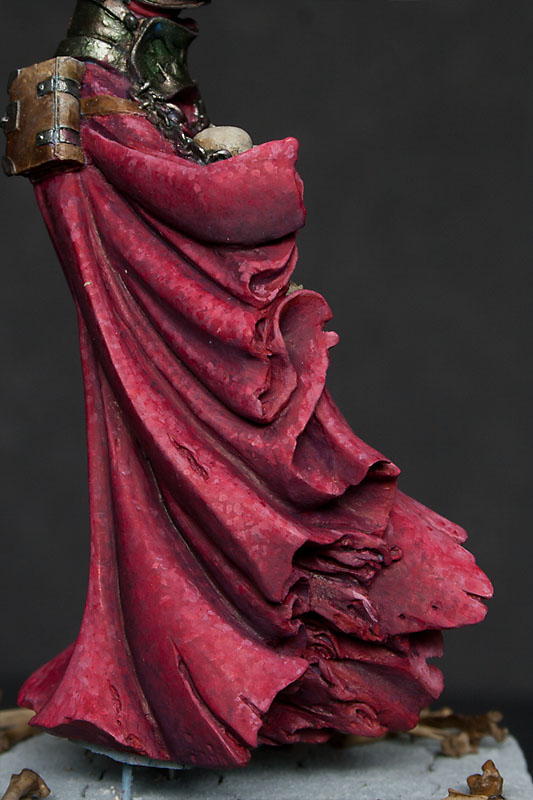
This time I'll try to explain how I did the velvet robe on Menhom Dark Shadow.


I started the robe as plain red. As you can see I even added some initial lights and shadows. But then I realised that this robe is big enough (I'd even say huge) to add some freehand, or maybe texture.
Because initially I was going for old and dusty look, the embroidery, I was going to mimic with freehand, would have to be fairly damaged. I wasn't sure  if I'll be able to do that, so I decided to go with crumpled velvet look.

To do that I decided to try 'doting' technique presented by Alexi_Z in her video tutorial. That was my first try, so the results are far from ideal, but I'm quite happy anyway. I learnt a lot doing that piece, and the next attempt should be more successful.

On the first two pictures you can see the initial shading on the robe. It's not perfectly smooth or too contrasty, but it's OK. I'm gonna cover it with lots of dots.


When I made my mind how exactly I I'm gonna paint the robe, I did a little try on one of the creases to find out If I'm capable of pulling that off.


It looked quite nice, so I started to build shadows.
On the pictures below you can see how I was trying to control depth of the shadows not only by used colour, but also by placing more or less dark dots in the recesses.


Then I started to add dots with brighter colours to create lights. Like with painting smooth surface I was building lights gradually, by change of colour and placement of the dots.

Later it was mostly going back and forth with various shades to build a nice gradient. I used quite a lot of base colour to make shadows and lights less uniform. To soften the transitions a bit and made it look more like a fabric, not just collection of dots, I used some red glazes.


On the pictures below you can see the difference glazes did. Colour is more vibrant, and whole robe looks more consistent.


 And here, finished robe, with some final highlights on the edges.


And at the end, colours I used to paint the robe, maybe someone will find it helpful. I know that I'm using some really old and discontinued GW colours, but you can easily find something similar in other ranges.

Base:
Red Gore (GW)

Highlights:
1st light Andrea Flesh Paint Set
Offwhite (70820 VMC)

Shadows:
Liche Purple (GW)
Storm Blue (GW)
Black (70950 VMC)

Washes (GW):
Baal red
Devlan mud
Leviathan purple
Thraka green


cheers

'eM


29 Mar 2012

Little bones for basing

At the moment I'm preparing another base with natural bones, so I thought I might as well tell you how to deal with them in our hobby.

But first few informations:
1. No animals were killed to obtain these bones, well they were killed and eaten, but not by me and not for the purpose of collecting base accessories. Pure cruel nature.
2. Some people may feel disgusted by the process of acquisition of the bones... I must say I don't understand that, but... well... If you feel you might have weak stomach or feel sick for trivial reasons, don't read this article, find another way to make your bases look awesome:D


Where to fing such a tiny bones (the gross part begins:P):
As you probably know, owls have very weak stomach acid, and are unable to digest bones and fur (and  they swallow their prey whole or in small pieces) , so they vomit it after a while. Ornithologists call that vomit pellet.
There are other animals that do that (for example cats, hawks, eagles and other raptors), but the owl's, in particullar Barn owl's, pellets have the bones in the best condition (weakest stomach acid).
The important thing here to remember is: it's vomit not a poop, it comes out the front end not the rear!!

You can buy natural pellets on ebay, sometimes with bone charts, as children are using them sometimes at school at biology classes to reconstruct bone structure of little mammals.
There are also artificial pellets avaliable, but I have no idea how the bones look like in them.


What can we find in a pellet:As I said earlier pellets are masses of bone, teeth, hair, feathers and exoskeletons of various animals.
Here are types of the bones you can find there.
Of course it vary in every pellet. This is 100% natural thing and all depends what the owl eaten that day.
But normally you can find: Skulls, jaws, parts of the spine, ribs, tibias, and other long bones.


That's the picture of the bones I got from my 6 pellets. It will probably be enough bones for my entire hobby life.


How to dissect a pellet:
1.Use latex gloves, and a dust mask. Ideally, you should have obtained your pellets from a reputable dealer, who will ensure that these pellets can't transmit rodent-borne disease (there is a note on ebay auctions if the pellet was sterilised).

2. Begin to pull apart your pellets with your hands, slowly and carefully. This tiny pellet is filled with small, fragile bones that you'll want to preserve. If the pellet proves to be too hard, you may soak the pellet in water to soften it. That creates a muddy mixture of bones, fur and other things. I personally prefer to deal with the dry pellets than wet, but it's entirelly up to you.

3.Separate the mess of fur, feathers, and bones with tweezers. As you break the pellet into smaller and smaller pieces, you can soak your pellets in water to remove the fur and feathers from the bones. Place the bones gently to one side, in a clean container or on paper towels.

4. Clean the bones thoroughly and just to be sure put into a cleaning/disinfectant liquid for a day or two.

5. Dry the bones and store them in a container, making sure they are out of reach of children and pets, you know.
.. just in case.


At the picture below you can see the bones in comparison with 28mm miniature (Hasslefree Akanke).
They would look great as a monster's bones in this scale, and skulls can be used for example as a dragon's remains. With bigger miniatures we can use them (the bones) as parts of human's skeletons.


How to glue and paint the bones:

If I remember correctly I was using PVA glue, but I believe they should survive contact with super glue without problems. In fact I just tested it on a very thin bone, and there are no signs of dissolving.

Paint them as anything else on your base, use primer at the beginning and then paint normally. You can stop licking your brushes for a while when painting bones, it's an animal's remains after all, even if sterilised.
Just be careful when picking them up with your tweezer, they're fragile and can be crushed easily.
And of course wash your hands after touching them, just in case.


And at the end, here are examples, where I used the bones on my bases:


Next base with bones soon, maybe even tomorrow:D

cheers

'eM